
 The ancient kingdom of Benin was described in glowing terms by early European visitors. Europeans were shocked and awed to find a well-planned city. The Portuguese and early European travellers including historians called it a world class city. As far back as the 15th century Europeans termed it “Benin City”. The only city not yet conquered by the British in the late 19th century.
Currently there is no trace of the remains of the structure admired by the European travellers back in 1485 when the Portuguese first visited.
During the late 19th century, Omo n’Oba Ovonramwen (1888-1897) had exercised a monopoly over trade which the British found irksome. The Benin kingdom had rich natural resources of palm oil, rubber and ivory and she was independent of British control. However James Robert Philips and Captain Gallway the British vice Consul of Oil Rivers Protectorate were pushing for the British annexation of the Benin Empire and the removal of the Oba.
In March 1892, Henry Gallwey visited Benin City with a treaty to the Oba to abolish Benin slave trade and human sacrifices. The Oba agreed but later refrained when it became obvious that the document was a deceptive ploy intended to make Benin Kingdom a British colony. Oba Ovonramwen in anger issued an edict to bar all British officials’ and traders from entering Benin territories. However Claude Maxwell Macdonald the Consul Genral felt the Kings reaction was an insult and a violation to the accord and thus laid the ground work of war between Benin Kingdom and Great Britain.
In 1894 Brohomi the trading town of Chief Nana Olomu the Itsekiri leading trader was invaded and destroyed by a combined British Royal Navy and Niger Coast Protectorate forces. As a result the Benin forces increased their military presence on her Southern borders. For some unknown reasons the Colonial offices had refused to grant approval for an invasion of Benin City. During the early and later parts of 1895, there were 3 attempts to enforce the Gallwey Treaty. I sense that the reason the British were developing a cold feet in confronting the Benin warriors was the memory of the Battle of Isandlwana against the Zulu warriors to which over 1500 Royal Marines were confronted in a Bull formation and slaughtered by the Zulu warriors. Though the British came back and broke the back bone of the Zulu kingdom….thanks to superior fire power versus spears. Also there was about to be unveiled a new weapon that could fire 600 rounds per minute and the end stage of the Maxim gun invented by Sir Hiram Stevens Maxim was almost done. It was not without fact that the British were a little scared of confronting the Benin warriors at first site even with their superior technology.
In March 1896 following a disagreement between Itsekiri middle men to pay the required tributes, the Oba ordered a cessation of the supply of oil palm produce to the foreign traders. There was now a trade embargo in the Benn River regions. British traders and agents quickly appealed to the protectorate consul general to invade Benin whatever the cost and send the king to exile or even kill him if he resists. The British traders and representatives held a meeting and it was agreed that Benin must be invaded. The British were also irked by the human sacrifices of the Benin kingdom and used that as the fundamental excuse to invade. Indeed human sacrifices was predominant in the Benin kingdom. However it must be noted that the early stages of the Ogisos, human sacrifices were never endorsed but as time went due to superstition and dark magic, false priest began to have a field day and the darker forms of priesthood became rampant in a once peaceful empire.
In November of 1896 a formal request was made to England for permission to invade Benin City by Philips. In late December 1896 without waiting for a reply or approval from London, Philips summoned about 300 soldiers of African and British descent. They were to enter Benin through deception and disguise and pretend they were masquerading in part as porters and traders to discuss with the Oba. They were to hide their weapons in bag gages. Part of Philips request to London was to depose the king of Benin and replace him with a Native Council, then pay for the invasion with the ivory and treasures he hoped to find in the Benin King`s palace. Philip then sent a message to the Oba that he wanted to come discuss trade and peace.
Unknowingly to Philips some Itsekiri trading chiefs had tipped the Oba that the British was planning an invasion and that he should be careful. When the Oba received the news from his spy network, he immediately summoned the captain of his warriors and palace chiefs. The Iyase Commander of the Benin forces argued that they should attack before the British get near Benin. But the Oba who had his doubt about the invasion wanted his warriors to allow the British enter Benin and then strike them with an ambush attack. The Iyase was angry. He told the Oba that the Igwe festival was about to be celebrated and that if the British came close, the Benin custom will be defiled as no Oba is allowed to see a foreigner during the “Igwe” festival. The Oba reluctantly agreed and so Iyase ordered his special forces headed by Ologbose to confront the British in a surprise attack.
On the afternoon of 4th January 1897, after several warnings by Benin citizens to Philips entourage that Benin was celebrating the Igwe festival that the Oba cannot see any foreigner, the Philips forces met a surprise attack by Benin strike force of Special Forces of the Obas special guards at Ugbine village near Gwato. Every one of them save two were massacred.
The shadow of Isandlwana on 22 January 1879 Anglo Zulu war had just repeated itself. Something London was avoiding all along. Benin Kingdom was over 100 years old and no matter how technological superiority played the game of battle, her people were prepared to die for their Oba and uphold the Benin territory for another hundred years.
It was now the turn of the British to retaliate. After this massacre, the Oba made a grave error of judgement. Instead of him to secure her water ways and dig in, he felt the lessons of the massacre of the British forces should send a clear signal of fear and thought the British were not going to return. His Iyase kept cautioning him to prepare and consult the oracle. One of his chiefs felt they should send a peace accord to the enemy. This was vehemently refused and that any attempt to panic will come with a beheading of the individual and all his households.
On January 12 1897 Rear Admiral Harry Rawson led the retaliatory attack code name “Benin Punitive Expedition”. The invasion of Benin began on 9th February 1897. 1200 Royal Marines moved in a three formation attack via Sapoba, Gwato and Main columns. The Sapoba and Main column met a fierce resistance and was bugged down by bitter arm to arm combat for 14 days but the superior might of the Maxim gun gained victory for the British. The Gwato column met the warrior commander Ologbose and his men. Ologbose was a fierce warrior in Benin. He is credited to use the help of the elements in conquering his enemies. The third formation by the British was annihilated by the Benin forces of Ologbose. However it was too late to save Benin City as the other two columns had entered Benin. Ologbose simply disappeared out of history.
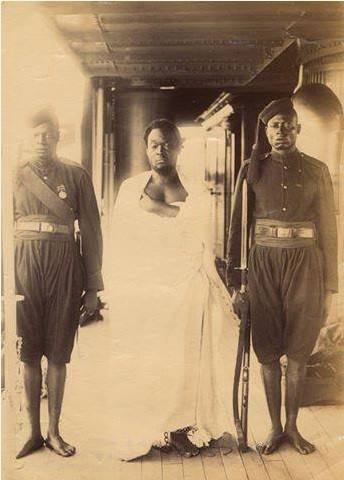
After the British invaders had secured the city, a massive looting of Benin treasures began. British admiralty confiscated priced treasures. The King of Benin was eventually captured by the British consul general Moor and sent to live out his days in Calaber. Oba Ovonramwen died of natural causes in 1914 while Moor who was the main planner of the invasion committed suicide in Barnes, Middlesex in 1909.
Thus ended the last stand of an African Empire that had stood for over 300 years.