
1.The last three-and-half years have been challenging both home and abroad. There have been disruptions in oil production in the country.
2.The economy has recovered from recession. We have done more work with less resources in Agriculture, Social Development and Infrastructure.
3. Real Gross Domestic Product growth stood at 1.81 percent in the third quarter of 2018 compared to 1.17 percent in the third quarter of 2017.
4. We have had a sustained accretion to foreign exchange reserves from a low of $28.57 billion in May 2015 to $42.92 billion by mid-December 2018.
5. Inflation has also declined from a peak of 18.72 percent in January 2017 to 11.28 percent in November this year.
6. As at the third quarter of 2018, the trade balance was a surplus of N681.27 billion representing a significant improvement from the deficit of N290.1 billion in 2016.
7. Capital importation to Nigeria in the third quarter of 2018 stood at $2.86 billion, which is a 56.7 percent increase compared to the corresponding period in 2016.
8. Real Gross Domestic Product growth stood at 1.81 percent in the third quarter of 2018 compared to 1.17 percent in the third quarter of 2017.
9. We have had a sustained accretion to foreign exchange reserves from a low of $28.57 billion in May 2015 to $42.92 billion by mid-December 2018.
10. Inflation has also declined from a peak of 18.72 percent in January 2017 to 11.28 percent in November this year.
11. Nigeria has moved from a deficit to surplus in our trade balance. As at the third quarter of 2018, the trade balance was a surplus of N681.27 billion representing a significant improvement from the deficit of N290.1 billion in 2016.
12. Capital importation to Nigeria in the third quarter of 2018 stood at $2.86 billion, which is a 56.7 percent increase compared to the corresponding period in 2016.
13. With regard to the oil and gas sector, crude oil production continues to increase steadily towards budgetary targets and will receive a further boost when the 200,000 barrels per day Egina oil field starts operations.
14. Nigeria was spending $5 million dollars a day on rice importation. Today rice imports have virtually stopped. Indeed, we are on course to achieve food security in major staple foods in the not too distant future
15. Ministry of Water Resources identified 116 abandoned or uncompleted projects relating to irrigation, dams, drainage and water supply. To date, we have completed and/or commissioned a number of these projects including;
16. In the railway sector, we completed and commissioned the Abuja-Kaduna Rail Line and the Abuja Metro-Rail Project. Similarly, the previously abandoned Itakpe-Ajaokuta-Warri Rail Line is undergoing test runs and will soon be commissioned. We are also on track for the Lagos – Kano rail line as significant progress has been made on the Lagos to Ibadan segment of the project.
17. In 2018, an additional 1,531 kilometers of roads have been constructed and 1,008 kilometers rehabilitated across the country. Priority projects such as the Abuja – Kaduna – Kano highway as well as the Second Niger Bridge are well underway through the Presidential Infrastructure Development Fund.
18. In every State of Nigeria today there is a major Federal road project going on. For instance:
19. In power, we are working on over 90 transmission projects across the country.
20. Through the N-Power scheme, 500,000 graduates have been employed to date;
21. The National Home-Grown School Feeding program is feeding 9,300,892 pupils in 49, 837 schools in 24 states across Nigeria, and empowering 96,972 cooks
22. The Government Enterprise and Empowerment Program has seen to the disbursement of 1,378,804 loans to small businesses and farmers in all states including the FCT. These are interest free loans that will be paid back;
23. 297,973 households in 26 states across the country are benefitting from the Conditional Cash Transfer program.
24. The volatility in oil prices, and disruptions in oil production, delayed our plans to recover past due oil license and royalty charges as well as restructuring of the Joint Venture Oil Assets.
25. Federal Government’s actual aggregate revenue was N2.84 trillion, which is 40 percent higher than 2017 revenue. The overall revenue performance is only 53 percent of the target in the 2018 Budget largely because some one-off items are yet to be actualized. We have now rolled this revenue item over to 2019.
26. Of the total appropriation of N9.12 trillion, N4.59 trillion had been spent by 30th September, 2018 against the prorated expenditure target of N6.84 trillion. This represents 67 percent performance.
27. Despite the delay in the passage of the 2018 Budget on 20th June 2018, the sum of N820.57 billion had been released for capital projects as at 14th December, 2018.
28. Total revenue is projected at N6.97 trillion (which is 3 percent lower than the 2018 estimate of N7.17 trillion), consisting of Oil revenue projected at N3.73 trillion while non-oil revenue is estimated at N1.39 trillion.
29.. We have allowed for N305 billion ($1 billion) for under-recovery by NNPC on PMS in 2019. We will continue working to bring it downwards so that such resources are freed up to meet the developmental needs of our people.
30. Today the government through the NNPC is the sole importer of PMS and therefore, the under-recovery is from the NNPCs trading account. This means the possibility of some marketers falsifying claims is removed.
31. A total expenditure of N8.83 trillion is estimated for 2019. This includes grants and donor funds of N209.92 billion. This provision is less than the 2018 FGN appropriated expenditure estimate of N9.12 trillion. However, it is higher than the N8.6 trillion originally proposed by the Executive Branch to the National Assembly for 2018.
32. The budget deficit is projected to decrease to N1.86 trillion (or 1.3 percent of GDP) in 2019 from N1.95 trillion projected for 2018. This reduction is in line with our plans to progressively reduce deficit and borrowings.
33. The sum of N2.14 trillion has been provided for debt service. Of this amount, 80 percent is to service domestic debt which accounts for about 70 percent of the total debt. Although our national debt is within sustainable limits, we need to increase our domestic resource mobilization to bring down our debt-revenue ratio over the medium term.
34. The allocation to the Social Intervention Projects (SIP) has been retained at N500 billion, consisting of N350 billion recurrent and N150 billion capital. This reflects our continued determination to pursue inclusive gender-sensitive and pro-poor growth.
35. In addition, to maintain the peace in the Niger Delta, the provision of N65 billion for the Presidential Amnesty Programme has been retained in the 2019 budget. Similarly, the sum of N45 billion Naira has been provided for the North East Intervention Fund, as well as the sum of N10 billion Naira as take-off grant for the North East Development Commission.
36.Inflation has declined from 18.2% in January to 11.28% in November. Foreign Capital Influence has also improved.
37.We have included the implementation for the National Minimum Wage. I will be sending a Bill to this National Assembly, on this.
38.To further support SME’s, we have set aside N15 billion while the sum of N10 billion has been granted to BOI for this purpose.
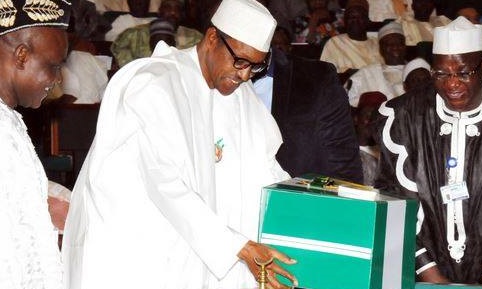
39.This is my last Budget Speech to the 8th National Assembly.