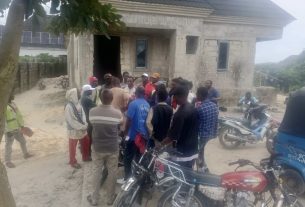


The popular saying that “water is a free gift of nature” appears to be more than rhetoric to the residents of Issele-Mpitime town in Aniocha North Local Government Area of Delta State as they solely depend on rain as their only source of water all year round.
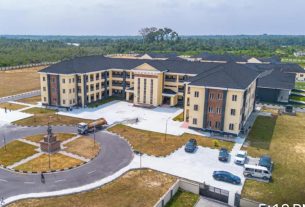
The first thing that would probably greet a first time visitor to the community is a giant signpost erected beside the local government’s main gate along the Issele-Uku/Issele-Mpiteme Road with a bold inscription: “Tax Payers’ Money at Work.”
Well, if you think ‘tax payers’ money’ is really at ‘work’, you may be in for a shocker as our correspondent who visited the town earlier in the week would find out.
With lack of good roads, zero power supply, below average health care centre, terrible road networks and of course, lack of potable water, the signpost was a mere decoration that means the opposite of what it stands for; the tax payers’ money is working in reverse gear.
Of all the challenges facing the town, lack of potable water is the most worrisome as this town only depends on rain water all year round.
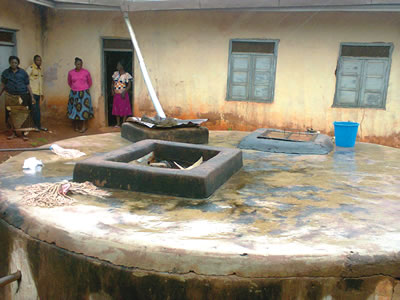
The situation, ironically, affects everybody in the town – the poor, the rich and even the mighty- everybody depends on the rain water to quench their thirst, wash, bathe and cook.
Having realised that they may have to wait till eternity for the government to fulfill its promises, especially in the area of provision of potable water, the about 10, 000 residents of the agrarian town have now taken their destinies into their hands as they individually resorted to building wells to serve as reservoirs to store rainwater for drinking and other domestic use during the rainy season.
Virtually all the households in the town have carefully channelled all the rain drops that fall on their respective roofs into their wells.
In a chat with our correspondent, some residents of the town lamented that in spite of all efforts to supplement the rainwater, like digging wells and boreholes, they have never succeeded thus making them to continue to depend on the water from heaven.
Our correspondent saw a 35-year-old expectant mother, who identified herself as Grace, struggling to draw water from the well built by her husband beside their house.
Grace, who found it difficult to pull out the pail from the well as a result of her protruding tummy, expressed her frustration over repeated efforts by her husband to provide a borehole for the family use without success.
“Everyone in the town depends on rain as the source of water for their drinking and other domestic usage. All efforts by my husband to provide borehole failed because of the topography of this town. Even the richest man in the town depends on rainwater; the man has tried all within his power to drill borehole all to no avail,” said Grace who claimed that she grew up to meet the situation like that.
Indeed, what Grace said concerning rich men depending solely on rain water as well, was not far from the truth going by our correspondent’s findings.
The Isama of Issele-Mpitime, Chief John Ikediashi, who may be described as one of the averagely comfortable men in the town, also expressed his frustration in drilling a borehole as another source of water. The only source of water to him and other members of the community is still the rainwater.
“The rain is our power; we depend on rainwater for everything in this town. We drink rainwater year in year out. We don’t have another source of water supply. The two boreholes the government constructed for us are not functioning; the government just abandoned the projects half way.
“Our main occupation is farming. Even, we wish rain can fall two times every week, including the dry season so that those who cannot afford reservoir can stop scooping water from ogodo (swamp) for drinking,” Ikediashi said.
Asked about the litres of rain water that can last a relatively small family till the next rainy season, he said, “A small family needs N250, 000 to dig a well of 22 feet deep and 10 feet wide to serve as reservoir that will contain about 60, 000 litres of rainwater to last for maximum of seven months, depending on the family’s ability to manage the water.
“Treating the water is another problem. While some people may afford the services of experts to assist in treating their water especially if it has been stored for about three months, others with no financial capability will have to drink the water untreated,” he said.
Ikediashi, who is a transporter with an average means of livelihood, was unhappy when our correspondent asked him how people got water during dry season.
He said, “Those who cannot afford to buy 5, 000 litres of water for N10, 000 from suppliers from Onitsha during dry season depend on ogodo as their source of water.”
But lack of potable water is not the only challenge the community has to contend with.
Chief Nwaolise Okuka, the Onihe of the town, who is the acting Obi(ruler), listed other issues confronting the residents.
“Aside the issue of water, our hospital lacks basic facilities. We will be happy if a doctor can be visiting our hospital even two times in a week so that we too can enjoy government’s presence. Our roads are also bad. Even the only road that leads to our Primary Health Care Centre is in poor state,” Okuka said, while encouraging our correspondent to go round the town to confirm his allegations.
And while going round the town as Okuka suggested, our correspondent saw a woman who identified herself as Patience Dihi drawing rainwater from a well built beside her house.
“The only thing we enjoy in this town is nature. We depend on the rain for everything. Our major prayer is that God should not allow drought to affect us in this village. If that happens, only God knows what will become of everybody, particularly those that cannot afford to buy water from suppliers from Onitsha, Anambra State,” Patience said.
Patience inferred that a Good Samaritan in the town would find it difficult to part with water. It is really a ‘hot cake’.
She said, “If you know how we suffer because of water in this town, you will not ask me to give out water to anybody. Many of us cannot afford to buy water from suppliers from Anambra State so we have to manage the little we have.
“We also trek about five kilometers to fetch water from a pond in a far away bush. Since the two boreholes the government built for us never functioned at all, wisdom dictates that someone needs to be mindful of the way he/she uses or gives out water.”
Patience, who showed our correspondent where boreholes built by the government were located, said the water challenge would be lessened if only the boreholes would function eventually.
“We will be happy if the government returns to the sites and fix the boreholes so that we won’t have to trek a long distance to scoop water from ogodo during the next dry season,” she said.
To say that the boreholes were not functioning would just be understating the obvious going by the sight that greeted our correspondent when he got to the place the boreholes were drilled.
The abandoned boreholes have long been overtaken by weeds giving credence to the residents’ decision to take their destinies into their hands.
If the residents have been able to slightly overcome the water challenge in a way – all thanks to natural resources from heaven, they are still faced with other challenges, which keep deteriorating by the day.
Issele-Mpitime, which is about 30 kilometres away from Asaba, the Delta State capital, is battling poor health care facility. Actually, the town has two primary health care centres but both can only boast of non-functional facilities and unqualified health personnel. One of the centres was abandoned and taken over by weeds while the other had just one nurse and three supporting staff and then, four beds out of which just two had mattresses.
The health centre, of course, had a well which contained rainwater for use by workers. But then, the health centre’s well was not adequately protected as two dirty mopping items were placed on it.
One of the workers at the health centre, who did not want her name mentioned for fear of being sanctioned for talking to the press, told our correspondent some of the challenges confronting the facility.
The nurse disclosed that patients’ relatives would have to provide water to the hospital to facilitate the treatment of their loved ones.
She said, “We depend on rain to do our work. When there is no water, patients’ relatives sometimes bring 50-litres minimum of water from their houses to enhance the treatment of their people.”
Apart from lack of potable water supply, the community lacked electricity as residents informed DeltaNewsroom.com they hadn’t seen any form of power supply in the last six years.
“The last time we had power supply in this town was six years ago. Once it is 7.pm, we can hardly attend to patients because we don’t have electricity. Even, we don’t have small generator that can supply us power,” the nurse said.
A man, who simply gave his name as Emeka, expressed how bad the situation had been in the last six years.
“We will be happy if we can just have electricity for two weeks so that we can shout ‘Up NEPA’, we would have the feeling that we are still in existence,” Emeka said.
But it appears that the residents may not have power supply in the nearest future as the sites of the two transformers purportedly provided by the government to serve the town had been again overtaken by weeds.
The Issagba of Issele-Mpitime, Chief P. M. Okafor, expressed regret that the situation had robbed the town of necessary development as teachers don’t always stay when transferred there.
Okafor said, “We are a forgotten people. The situation has taken almost a decade. It is embarrassing that a town that once enjoyed pipe borne water in the 1970s through 1980s is now suffering in this millennium.
“We depend on water brought from other towns for our sustenance. Those that cannot afford to buy rely on water from a stagnant pond. Our children and their mothers trek about six kilometers to fetch water from the pond, which is not good for drinking.
“The government abandoned the boreholes it provided for us when we asked that they should be test-run before they commissioned them.
“What we have is mere building and not health centre; we don’t have competent medical officers in what they call a health centre for us. Even if a doctor can be visiting two times in a week, we can say we have a health centre.
“The most painful aspect is that we are not progressing because the last time we had electricity was six years ago. Teachers don’t like to stay in the town whenever they are transferred here.”
Despite the plights of the people and their complaints, the councillor representing Ward 5 of Issele-Mpitime at the local government secretariat who introduced himself as Hon. Ikenwa, refused to speak with our correspondent when he was asked about the effort the government was making to assuage the people’s suffering.
But the vice-chairman of the local government, Lady Ezinne Nduka, described the situation as a general problem as she said the council’s authorities were hampered by lack of funds to fix the boreholes.
Nduka said, “My village is also suffering the same problem. We get N49m monthly as allocation to pay salaries after which nothing is left to execute any project. So, the council cannot help the situation.
“Last month, we paid N53m as salary; we had to borrow money to pay our workers.
“We are just a caretaker committee and we are not entitled to execute projects; it is the responsibility of elected officials to execute projects.”
Experts have however said constant consumption of rain water may be risky to health.
A public health physician, Dr. Rotimi Adewumi, told our correspondent during a telephone chat that rain carries impurity from the air as it falls.
According to him, taking rainwater in an environment that is exposed to constant burning of firewood is harmful to health.
Adewumi said, “There are carbon dioxide, sulphur dioxide, and nitrogen oxide in the air. They come from smoke and when they are mixed with water, they give acid rain. In Chemistry, water plus carbon dioxide give carbonic rain. The acidic rain may likely cause ulcer if taken into empty stomach. Ulcer is a wound in the tummy. It is like somebody drinking an acid.
“The acid rain is a weak form of acid, it may still cause ulcer, which is abdominal disturbance.
“The other part is rain carries dirty things like animal waste especially when it falls on the roofs. Constant drinking of such rainwater can also cause diarrhoea.”