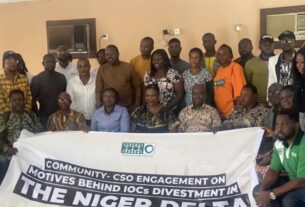

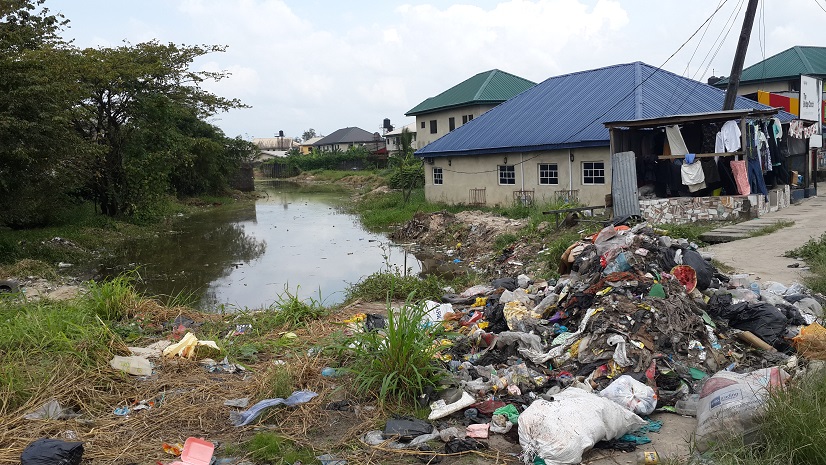
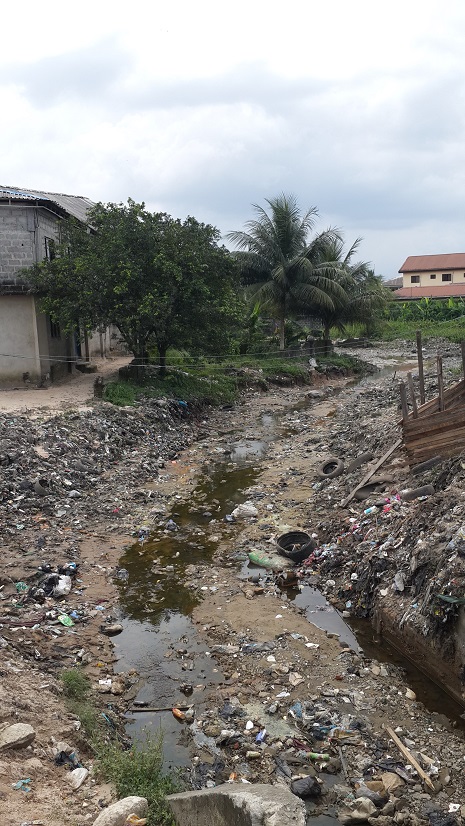
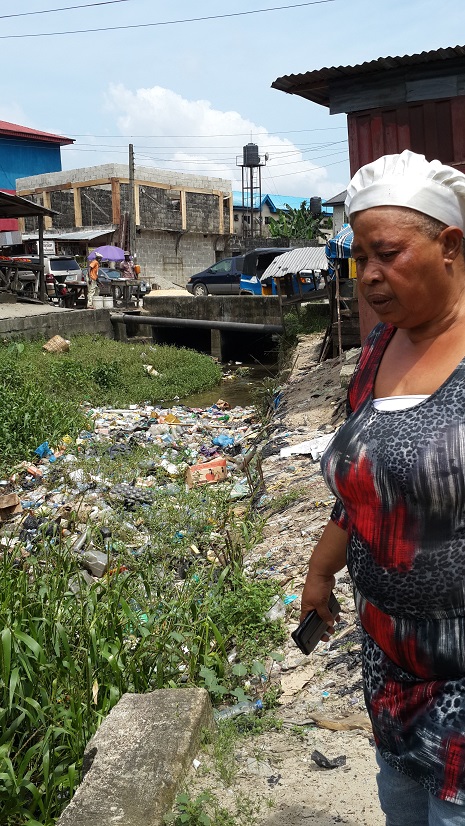
 The Asabiro stream which flows to the Warri River was a major source of potable water for the peasants of Ekpan, Uvwie Local Government Area of Delta before the 1980s when the sitting of the Warri Refining and Petrochemical Company triggered a maelstrom of oil activities and an influx of oil workers to the serene community and its environs. The crystal clean Asabiro stream used to flow through a rubber plantation and a fish camp. The area, a tableland with cassava farms sloped into the swampy rubber plantation and bamboo forest with wild palms and kola nuts trees.
The rapid urbanization of the community like most villages in the Niger Delta, resulted in an unprecedented generation of both human and industrial wastes, and due to inept governance and lack of proper environmental regulation, these wastes eventually found their way to streams in the region, resulting in pollution, stagnant waters, flooding and disease.
A community leader in Uvwie, Chief Bridget Eregha and one Madam Aghogho, a farmer and trader, recalled how the Asabiro stream was before the advent of oil companies and the resulting influx of oil workers. While taking the reporter around the Asabiro stream which is now polluted with both human and industrial waste, she said the stream used to be a clean source of drinking, bathing and washing water after the day’s work on the farms.
All over the Niger Delta, streams which used to provide water for drinking and other domestic uses have been polluted and the governments have done, and are still doing very little to ameliorate the plight of the communities.
Cholera and other water borne diseases which were unheard of are now very common phenomena. The research and documentation department of the Delta Ministry of Health reports that in the last six months, 150 children and 87 adults were diagnosed with chronic cholera cases.
Also recently, Chief Emere Godwin Bebe Okpabi, leader of Nigeria’s Ogale people, unpacked four bottles of water from his homeland and lined them up on a table to show the world why his subjects are suing Royal Dutch Shell in a London court.
The Nigerian water is contaminated with oil and cancer-causing compounds such as benzene. It is what his people drink every day.
“In a 2011 report, the U.N. said that in at least 10 communities in Ogoniland, public health was “seriously threatened” by drinking water contaminated with hydrocarbons. In one area, the water contained the carcinogen benzene at levels 900 times higher than what the World Health Organization says is safe.
While the report recognized that oil production in the region had ceased, it criticized Shell’s oversight of the remaining facilities.
The report recommended emergency measures to provide adequate drinking water. But so far nothing has been done”- King Okpab of Ogale said
Lawyers for more than 40,000 Nigerians are demanding action from Shell to clean up oil spills.
Britain’s High Court began hearing lawsuits on Tuesday(22/11/16) filed by the Ogale and Bille people alleging that decades of oil spills have fouled the water and destroyed the lives of thousands of fishermen and farmers in the Niger River Delta, where a Shell subsidiary has operated since the 1950s.
They brought their fight to Shell’s home base because they say the Nigerian courts are too corrupt.
“Let the shareholders of Shell who are residents of the advanced world, like Britain, let them see a representative of a kingdom that is being destroyed for them to have money,” he told The Associated Press news agency on the eve the hearing. “That’s blood money.”
The Anglo-Dutch oil giant argues the case should be heard in Nigeria, pointing out it involves its Nigerian subsidiary SPDC, which runs a joint venture with the government, and Nigerian plaintiffs.
London law firm Leigh Day is handling the cases after it won a landmark agreement from Shell to pay $83.5m in compensation to the Bodo community for damage caused by oil spills in 2008 and 2009.
Shell originally offered $50,000 before the Bodo took their case to the same UK court.
The new lawsuits were brought by two communities located in Ogoniland, part of the oil-rich southern Niger River Delta.
They want to hold Shell, incorporated in the UK, responsible for the actions of its Nigerian subsidiary, Shell Petroleum Development Company of Nigeria Ltd, or SPDC.
According to a report by John Kanayochukwu Nduka, Orish Ebere Orisakwe, in Delta State, high levels of cadmium were found in Ijala creek, Ubeji creek, Jeddo River, and Ekpan River, respectively. High lead levels were seen in Jeddo River, Ekurede–Itsekiri Creek, and Ughelli River. In River State, Tombia River had the highest levels of chromium, lead, and nickel. Ijala creek, Eja-Etan, Ifie-Kporo, Ubeji Creek, Jeddo, Ekpan Rivers, and Ekurede–Itsekiri Creek, all in Delta State, presented highest salinity levels. Orash River, Ughewhe stream, and Egbo stream have a lowest pH of 5.22, 5.32, and 5.53, respectively, while Ifie-Kporo River have a highest pH of 8.18.
Most of the metal levels were above US EPA Maximum Contaminant Level MCL indicative of water pollution which may be of public health importance, and recommended water-quality monitoring.
Another report by a group of Petroleum Training Institute, Effurun, scientists, said the Orogodo River is one of the numerous freshwater bodies that abound in the Niger Delta area of southern Nigeria. It is a typical municipal stream flowing through Agbor town with a population of over 100,000 people (Arimoro et al, 2008). The river is subjected to organic pollution load arising from the effluent discharge from the abattoirs stations along the river bank, which comprises of stomach and intestinal contents of slaughtered animals, ashes of burnt animals materials that are slaughtered daily that makes up an enormous volume of waste discharge regularly into the stream without treatment. Furthermore, the river is influenced by frequent disturbance from human and animal activities which if not properly managed can pose severe health risk to the populace. They stressed the need to assess the level of heavy metal contamination in Nigeria water sediments and also see the effect of these contamination to the aquatic life and ecosystem in general.
Their work covers sampling of whole sediment and analysis to ascertain the level of contamination of heavy metals in River Orogodo.
The consistent sediment collection, holding time consideration, sediment manipulation and storage methods were used to help provide high quality samples with which accurate data can be obtained for the national inventory and for other programs to prevent, remediate, and manage contaminated sediment and this work would also attempt to make some recommendations.
MATERIAL AND METHODS
Description of the study area
River Orogodo lies between latitude 5°.10’-6°.20’ N and longitude 6°.10’—6°.21’E (fig. 1) The River is fed principally by ground seepage from an aquifer in the thick rainforest of Mbiri and secondarily by precipitation, municipal effluence and surface run off from the riparian communities. The River flows through the major town of Agbor in Southern-Nigeria. The river substratum consists mainly of fine sand mixed with mud and occasionally with coarse sand and pebbles. Decaying macrophytes and debris also form part of the substratum. The climate of Agbor town and its environs, although comparatively stable, is not uniform. A rhythm of rainfall occurs in conjunction with movements of the southwest Monsoon winds across the Atlantic Ocean and the timing of these movements varies from year to year.
Site I
The station is located at the point of discharge of effluents from the Agbor Abattoir. The abattoir effluent is mainly organic, made up of faeces, blood and ashes produced during the slaughter, roasting and burning of animals (donkeys and cows). This station is exposed to direct heat of the sun and has heavy algal growth in some areas but, with very few macrophyes (Nymphae lotus, Azolla spp, utricularia sp and Salvinia sp.) and duckweeds (Lemna) closed to the banks. The steambed is covered by coarse sand. The current velocity is relatively fast (mean value = 0.58 ms-1). Average depth is about 0.5 m and width 5.8 m/ Rubbish and domestic waste from the town are emptied into the river few kilometers from this station during heavy down pour (Arimoro et al, 2008).
Station II
The sampling station is located within the main town at Agbor, about 500m from site I and has a depth range of 0.38 m – 0.50 m. The current velocity ranges from 0.58 – 0.68 ms-1. This site is heavily perturbed by various human activities including laundering, car washing, dumping of refuse and defecation by both humans and livestock. During the early hours of the day, nomadic cattle herders take their animals to this site to drink and feed on grasses by the side of the river, coincidentally voiding their excreta into the water. The sparse vegetation in this site consists mainly of commelina, Nymphaea sp., Pancium repens, Pistia stratiotes and Vossia Cuspidata.
Sample collection
High density polyethylene container was chosen because its relatively inert nature and generally unbreakable. All the sample containers were soaked for seven days in hydrochloric acid (HCl), followed by seven days in nitric acid (HNO3) and finally Seven days in deionized water. The cleaned containers were labeled, (US EPA, 2001).
The bed sediments were collected in each station using 20cm Birge-Eckman grab sampler and transferred into the cleaned containers.
Sample transport and storage
The transport and storage method was designed to maintain structural and chemical quality of the sediment. The sediment collected was transferred from the sampler to the sample container where it was temporarily stored and transported immediately to the laboratory for the next stage.
Sample preparation
In the laboratory, samples were air dried for two weeks before grounded into fine particles using pistil and mortar and sieved through a 2mm sieve.
About 200g of the sieved samples were sub sampled by quartering for analysis. Extraction of metals from sediment, using mixed acid digestion method was done. 20ml of a mixture of concentrated HClO4 and HNO3 at a 2:1 ratio (v/v) on a hot plate and the mixture was heated to almost dryness. 20ml of HNO3 was added to the solution and filtered in to 50ml volumetric flask through whatman 42 filter paper. The filtrate obtained was made-up to 50ml mark with distilled water.
Laboratory Analysis
The pH of sediment samples were determined using Jenway pH meter (model 3520) following the procedure described by Hender short et al (1993). Total organic matter and conductivity were analysed following the procedure described by Radojavic and Bashkin, (1999). The total concentration of heavy metals was determined using Atomic Absorption Spectrophotometer (Unicam, model 969). All acid used were analytical grade and Quality Control was assured by the use of procedural blank.
DISCUSSION
The mean of four (4) month variation results of specific physicochemical characteristics and some heavy metals analysed in River Orogodo sediments within the study area are presented in table two (1). The pH was slightly acidic in a range 5.58- 6.34, which is peculiar to Nigerian soil/ sediment ( Odu, 1996). The low pH condition affects metal speciation and may enhance metals’ solubility and possible leaching into the water column.
High acidity of sediment has been attributed to a combination of possible oxidation of pyrity (FeS2) in the sediment to produce sulfuric acid, depleted calcium level or increased aluminum concentration in sediment (Odu, 1996).
The result of the total organic matter lies in the range of 0.09- 0.19 (%wt). Total organic matter influenced the other physical and chemical sediment characteristics including reserve of exchanged bases and interaction and dynamics of trace metal, hence maximum soil/sediment capacity for heavy metals are adjusted according to these macro-nutrients DPR (2002). Organically bound metals may dissociate as free ions and participate in cation exchange reactions with various minerals and leaving organisms, depending on ambient pH, ionic strength and temperature. Hence the organic matter of sediments is known to play a major role in determining the bioavailability of heavy metals (Adams et al, 2002).
According to Prof. A.B.M. Egborge Historically, drinking of river water must be nearly as old as the creation of man although the first book of Moses reports the use of water for irrigation (see Genesis 2-10.”And a river went out of Eden to water the garden…” As it was in the beginning so it is today except that municipal water supply schemes also cater for fish farming and industries. This last use of river water produces wastewater and heat which together with solid waste disposed uncontrollable conflict with the use of the water as a municipal source. In the United States of America, Europe, etc as in Nigeria there are standards for surface water quality acceptable for beneficial use (fish farming, irrigation, industries), drinking water from potable public supplies and wastewater effluent standards which regulate discharges of industries into surface waters.
Drinking Water
Prior to the arrival of FEPA, Nigeria public water supply standards have been based on US standards published in Standard Methods. In the developed world with the state of the art equipment for determining levels of contaminants in water samples, set standards are met.
In Nigeria, drinking water quality are impaired by run-off discharges, organic and inorganic matter. Rivers/streams in which organic matter is discharged show zonation beyond the point of discharge/mixing. These are:
- Zone of degradation
* BOD (Biological Oxygen Demand) rises sharply
* DO (Dissolved Oxygen) reduces drastically as a result of satisfying BOD.
- Zone of active decomposition.
* DO reduced to minimum
* Bacterial and fungal activities increase
* Anaerobic decomposition of bottom sediments produces odours
* Ammonia Nitrogen increase sharply as
* BOD drops
* Animal life decreases and eventually vanish.
This recovery from pollution is due to the self-purification capacity (SPC) of all rivers/stream. SPC which assures the assimilation of wastes and restoration of good quality is higher in shallow fast flowing rivers with high re-aeration than in deep/slow flowing rivers with low re-aeration.
In many rural riverine communities river water is the main source of drinking water. In communities close to the Atlantic Ocean high saltiness in river waters makes them unfit for consumption and hence the following statement is applicable in these areas: “Water, water, water everywhere, but none to drink.”
Remedial Measures
* Waters abstracted from rivers for municipal supplies or drinking must be subjected to prescribed laboratory tests to ensure conformity with set standards.
* Where laboratory tests are not possible such waters must be
- Taken upstream of the discharge of sewage or inorganic chemicals
- Stored in a storage tank and allowed to sediment in its own time or with the addition of alum.
- Boiled and cooled before drinking. Apart from killing a lot of living organisms including bacteria, boiling expels free carbondioxide and improves the pH (hydrogen-ion concentration).
- Desalinated in communities close to the Atlantic Ocean.
Industrial Water
All industries located close to river banks produce wastes which affect the normal life of the river. There are records of pollution of Warri River by refinery, steel and other industrial effluents, water of rivers, creeks, etc. around the fertilizer plant at Onne in Rivers State and many water systems of the coastal oil producing zones by spilled petroleum. Benin River water of Ogorode, Sapele are polluted with boiling waters discharged from the NEPA thermal plant. Although wastewater effluents standards regulate discharges of industries into surface water, monitoring to ensure compliance in Nigeria appears to be an impossible task.
Remedial Measures
Political, social and ethnic considerations have influenced the distribution of FEPA outstations. The most pollution endangered part of Nigeria is the oil producing coastal zone. While the zonal office located in Port Harcourt can be justified, the office in Benin meant to cover the oil producing western Niger Delta is misplaced and should be relocated to Warri. For effectiveness local government councils should be charged with the responsibility of monitoring their environments. For this purpose enough money for the establishment of suitable laboratories should be provided on the basis of graded pollution index of each local government area.
Points of discharge of wastewater effluents by industries within the vicinity of the same river should be re-examined with a view to relocating them downstream of the river and on the same side to allow passage of aquatic organisms on the other side.