

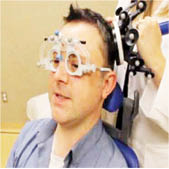
Stimulating a particular region in the brain via non-invasive delivery of electrical current using magnetic pulses, called Transcranial Magnetic Stimulation, improves memory, reports a new Northwestern Medicine study.
The discovery opens a new field of possibilities for treating memory impairments caused by conditions such as stroke, early-stage Alzheimer’s disease, traumatic brain injury, cardiac arrest and the memory problems that occur in healthy aging.
“We show for the first time that you can specifically change memory functions of the brain in adults without surgery or drugs, which have not proven effective,” said senior author Joel Voss, assistant professor of medical social sciences at Northwestern University Feinberg School of Medicine. “This non-invasive stimulation improves the ability to learn new things. It has tremendous potential for treating memory disorders.”
The study, published August 29 in Science, also is the first to demonstrate that remembering events requires a collection of many brain regions to work in concert with a key memory structure called the hippocampus – similar to a symphony orchestra. The electrical stimulation is like giving the brain regions a more talented conductor so they play in closer synchrony.
“It’s like we replaced their normal conductor with Muti,” Voss said, referring to Riccardo Muti, the music director of the renowned Chicago Symphony Orchestra. “The brain regions played together better after the stimulation.”
The approach also has potential for treating mental disorders such as schizophrenia in which these brain regions and the hippocampus are out of sync with each other, affecting memory and cognition.
The Northwestern study is the first to show TMS improves memory long after treatment. In the past, TMS has been used in a limited way to temporarily change brain function to improve performance during a test, for example, making someone push a button slightly faster while the brain is being stimulated. The study shows that TMS can be used to improve memory for events at least 24 hours after the stimulation is given.
It isn’t possible to directly stimulate the hippocampus with TMS because it’s too deep in the brain for the magnetic fields to penetrate. So, using an MRI scan, Voss and colleagues identified a superficial brain region a mere centimetre from the surface of the skull with high connectivity to the hippocampus. He wanted to see if directing the stimulation to this spot would in turn stimulate the hippocampus. It did.
“I was astonished to see that it worked so specifically,” Voss said.
When TMS was used to stimulate this spot, regions in the brain involved with the hippocampus became more synchronized with each other, as indicated by data taken while subjects were inside an MRI machine, which records the blood flow in the brain as an indirect measure of neuronal activity.
The more those regions worked together due to the stimulation, the better people were able to learn new information.
Scientists recruited 16 healthy adults ages 21 to 40. Each had a detailed anatomical image taken of his or her brain as well as 10 minutes of recording brain activity while lying quietly inside an MRI scanner. Doing this allowed the researchers to identify each person’s network of brain structures that are involved in memory and well connected to the hippocampus. The structures are slightly different in each person and may vary in location by as much as a few centimetres.