
“Recall that the opposition and their sympathisers and campaigners, both local and international, with their malicious propaganda, tore our economy to shreds, threatened our stability and existence as a nation and intimidated our citizens, all in the bid to take over power.
Rather than forge a coalition and build on the momentum we had gathered when they eventually took office, they went on a persecution spree and vengeance mission. That the country slipped into recession soon after we left office was a self-inflicted injury caused by misplaced priorities. The narrative of inheriting empty treasury is a blatant lie.
Also, the excuse of the collapse of world crude prices does not hold water. This is because the Fourth Republic took off in 1999 with crude oil selling for less than $20 per barrel and a Gross Domestic Product (GDP) growth at 0.58 per cent, according to National Bureau of Statistics (NBS) figures. Yet, the economy maintained a steady growth from that year, peaking at 15.33 per cent in 2002 when the average crude oil price was about $25.
It is also instructive that the oil and gas sector constitute about 11 per cent of our GDP. There had to be a wider causative factor than just the fall in world crude prices.
“It also amounts to standing facts on their heads to continuously claim that recession was caused by so-called mindless looting. The truth is that the opposition, in a bid to undo our government, became its own undoing when it got to power, because of the burden of justifying deliberate misrepresentations.
There is wisdom in the saying that if you win a prize and get the crown, don’t go around destroying the person who previously held that prize; it will lose its value.
Even after winning the election and forming the government at the centre, the blame game continued. When two brothers fight to death, it is the neighbour that inherits their father’s wealth. And we have seen neighbouring nations like the Republic of Benin and Ghana reaping from the capital flight out of Nigeria.”
He said with the calibre of people he had in his government, no one could say they were clueless.
“Just consider that my minister of state for health, Dr Muhammed Ali Pate, is now a professor at America’s Duke University, as well as a Senior Adviser to the Bill and Melinda Gates Foundation based in Washington DC. My minister of Agriculture, Dr Akinwunmi Adesina, is now the President of the African Development Bank (AfDB).
My Co-ordinating minister, Mrs Ngozi Okonjo Iweala, is the chairperson of the Board of the Global Alliance for Vaccines and Immunization (GAVI) and the African Risk Capacity (ARC). She also sits on the board of Twitter and the Asian Infrastructure Investment Bank, just as she is a Senior Adviser at Lazard and a Director at Standard Chartered Plc in the United Kingdom, amongst others.
My minister of communication technology, Dr. Omobola Johnson, is currently chairperson of custodian and Allied Insurance Limited as well as the Global Alliance for Affordable Internet. And it is not just members of my cabinet. Others who served with me in different capacities are also soaring on the world stage.
A good example is Ms. Arunma Oteh, who I appointed the Director-General of the Securities and Exchange Commission (SEC). Under her steady and skillful direction, Nigeria’s equity market grew in metric proportions, and by the time I left office in 2015, the market had tripled in size to $150 billion in value. Two months after I left office, Ms. Oteh was appointed a Vice-President and Treasurer at the World Bank.
With such personalities on my cabinet, no one can factually say we were ‘clueless’ or inept. The evidence of performance is simply overwhelming. We gave Nigeria an impressive and steady GDP growth rate at 6.7 per cent per annum.
We were officially cited as the third fastest growing economy in the world by CNN Money in 2014. We eradicated polio and guinea worm and became the first nation in the world to defeat the Ebola virus, such that the then richest man in the world, Bill Gates celebrated us for our prowess in the health sector. We reduced our food import bill by 36 per cent.”
Goodluck Jonathan, former President, says it is possible for an individual to be corrupt without stealing a kobo.
“Immediately after the 2011 elections, my administration was repeatedly accused of being corrupt,” Jonathan said in the chapter 5 of the book, titled ‘Corruption And The Blame Game’.
“Despite the blackmail, I remained committed to combating corruption in a systemic way, knowing it was endemic. We vigorously devised and implemented a thorough and strategic plan to fight corruption, using technology, albeit within the context of the rule of law and due process.”
Jonathan went on to explain his ideas about corruption, but only after he had denied ever saying ‘stealing is not corruption’.
“Before I go deeper into this, let me address a false narrative my detractors have used to besmirch my name. They claim that I once said that ‘stealing is not corruption’. This is not true. Following the constant stigmatization of Nigerians as corrupt, I invited the leadership of the legislature and judiciary to a meeting.
“In attendance were the Senate President and his Deputy, Speaker of the House of Representative and his Deputy; the Chief Justice of Nigeria (CJN), the President of the Court of Appeal, the Chief Judge of the Federal High Court and six States’ Chief Judges from each of the six geopolitical zones. Also invited were heads of two anti-corruption agencies viz, the Chairman of the Economic and Financial Crimes Commission (EFCC) and Chairman of the Independent Corrupt Practice and Other related Offences Commission (ICPC). I presided over the meeting with the Vice President.
“My thinking was that the executive arm of government alone could not effectively eradicate the scourge of corruption, hence the need for that meeting. I personally appealed to them and argued that only an all-inclusive approach could bring about tangible successes in the anti- corruption fight. The judiciary, the legislative and the executive arms of government needed to join forces if were to end the theft of public resources and stop corruption.”
He explained that he proposed that those present at the meeting should work together to curb corruption; ensure that matters of corruption are treated in painstaking and timely manner when presented to the courts, otherwise there would be no effective results; to encourage the parliament to play a fundamental role in passing strong and effective law, as the judiciary can only do little when laws are weak.
“The then Chief Justice of Nigeria, Honourable Justice Dahiru Musdapher, in his contributions acknowledged that he was of the same opinion. He added that because of the perception of corruption in Nigeria he had to isolate all the case files before the Supreme Court having to do with corruption charges,” Jonathan continued on page 45 of the book.
“He said that after reading through those files, he discovered that more than 70% were not corruption cases, per se, but crimes of stealing. The individuals involved were however not charged to court for stealing but rather in preparing the case files, the prosecutors used the term ‘corruption’.
“It was on the strength of his submission that I expounded to say that we should stop calling a spade an agricultural implement. Corruption does not fully capture the act of stealing. A person can indeed be corrupt without stealing a dime. Those who are incapable of comprehending this elevated thought and the mischievous crowd go about claiming till date that I said ‘stealing is not corruption’. They never bothered to even check the context in which I spoke. If you ask many of those clinging to that falsehood and mouthing malicious misrepresentation, to quote where I said it, they will tell you ‘they only heard’.
“Let me categorically state that I never said stealing is good and that people should steal, neither did the CJN. Stealing is stealing and instead of calling it corruption, let us call the thief by his proper name and not use a blanket word like corruption.
“Corruption encompasses many things. According to Transparency International, corruption is defined as the ‘abuse of entrusted power for the private gain’. The Merriam Webster’s dictionary defines stealing as ‘to take without permission or legal right and without intending to return’. If a government minister upon a cabinet dissolution takes a vehicle that he is not entitled to and converts it to personal use, then that is stealing. We must not lump everything together to say stealing is corruption. We must isolate stealing and make it as plain as day because Nigerians hate thieves. I abhor jungle justice, but we have witnessed Nigerians show their hatred for suspected thieves by burning them alive.”
The perception of the Jonathan administration as corrupt played a big role in the victory of the then opposition party at the 2015 presidential election. But Jonathan insisted that this was not so, otherwise his administration would not have “supported the institutional development of secure systems and mechanisms to curb corruption in public service and plug revenue leakages”.
“My administration spearheaded the development of the Treasury Single Account (TSA), the Integrated Personnel and Payroll Information System (IPPIS) and the Bank verification Number (BVN),” he added.
Jonathan said of the 2015 presidential election result: “I knew what was coming the day before I called General Muhammadu Buhari. I had reports on the polls around the country. It was clear the results were not going to favour me. Apparently, there were many instances of irregularities. There were series of problems with card readers, resulting from widespread technical hitches leading to the non-uniform application throughout the country.
“For some inexplicable reason, INEC had been able to achieve near 100% distribution of Permanent Voter Cards in the North, including the North East, which was under siege with the Boko Haram insurgency but failed to record a similar level of distribution in the South which was relatively more peaceful.
“Social media was filled with all manner of stories, pictures and videos. I was settled in my mind that I was not going to be the sitting President pointing out these infractions and accusing the opposition and the very INEC I helped to strengthen.
“The world saw my ordeal at the polling unit in my community in Bayelsa State, where the card reader refused my PVC, even after we tried repeatedly during accreditation. And it was the same with my wife and my mother. It was a moment that exposed the shortcomings of INEC.
“However, I was heading towards peace. Stopping the election on voting day would have been like detonating an atomic bomb. After we managed to vote upon filling the Incident Forms, I left Bayelsa for Abuja to monitor the elections and collation of results all over the country from the 29th to 31st March, 2015.
“The country was tensed. I had to do something. I could no longer wait for the collation of the final results. The pressure on the country was palpable. In Lagos, people were ready to burst loose on the streets and in the North; the stage was set for envisaged violence. One of my party’s agents at the INEC National Collation Centre in Abuja, Elder Godsday Orubebe eventually got into a heated argument with the INEC Chairman, Prof. Attahiru Jega. That further raised the tension in the country. Everyone was expecting the worst. I knew it was time to douse the tension.
Why I conceded defeat
“I was fully informed about the manipulations, intrigues, intimidation and betrayals. The consequences of not conceding were only better imagined. My natural instinct for peace automatically surfaced. I was going to make a decision which reflected my commitment to that ideal. This is the foundation of my essence. In my periodic projections into the future, I did not see how I would be presiding over any kind of chaos. I was prepared to promote the peace, unity and progress of Nigeria.
“This is a huge sacrifice, but I hope my readers believe me when I say it turned out to be one of the easiest decisions I ever took while in office. With my mind made up, I knew it was time to inject peace into the tensed polity, especially before INEC completed collation.
“I was in my living room with some ministers, aides and friends. Among them were the Coordinating Minister for the Economy/Honourable Minister of Finance, Dr. Ngozi Okonjo-Iweala, Honourable Attorney General of the Federation and Minister of Justice, Mohammed Bello Adoke, SAN, the Honourable Minister of Aviation, Mr. Osita Chidoka and Waripamowei Dudafa, my Senior Special Assistant on Domestic Affairs.
“They were recommending sundry alternatives, but I was quiet in the midst of their discussion. I hugged my thoughts, figuring out how to do that which was best for the country. My personal interest was receding rapidly and the interest of Nigeria looming large. I excused myself and left the sitting room. I walked into my study. Even here, my mantra was a strong circle around me, supporting and comforting me. Let the country survive. Let democracy survive. My political ambition is not worth people being ‘soaked in blood’.
“More reports flowed in and I could not wait anymore. The announcement of the final result could take issues out of all our hands. It was time for me to take action and bring peace to the nation. I felt I was destined by God at that point in time to inject the peace serum and douse the palpable tension in the country.
“I reached for the telephone and placed a call through the State House operators at about 4:45 pm. A peace I had never felt since my political sojourn, descended on me. It showed me where I had been in the past 16 years and where I was then. I smiled at the thought of what I was about to do. I waited calmly for the person at the other end of my call to answer.
Buhari: “Hello Your Excellency!”
Me: Your Excellency, how are you?”
Buhari: “I am alright, Your Excellency”
Me: “Congratulations!”
Buhari: “Thank you very much Your Excellency …”
“For several seconds the line was seized by the loudest silence I have ever known. Then we had a brief discussion. I could sense his relief too. He knew what could have been. Here is a man who had contested three times and lost. Maybe my gesture humbled him against his expectations because he thanked me and we talked about the handing over processes.
“Everywhere all over Africa, Asia and other parts of the world, countless deaths have been recorded on the scores of elections and power disputes. I mentioned Cote d’Ivoire earlier, where people died in their thousands during post-election violence. A similar scenario had unfolded in Kenya. African nations are more prone to post-election violence than other parts of the world. Only very few African nations have not experienced post-election violence on a very grand scale or some bitter power tussle fed by tribal or ethnic sentiments.
“I hung up the phone, confident that my decision was right for Nigeria and would probably have a great impact on Africa. This may well be the beginning of a new perspective to power; a perspective which places national interest above personal preference. It should not always be about winning.
“After my conversation with Muhammadu Buhari, which lifted my spirit greatly, I felt better and lighter; it was time to break the news to my Ministers and aides. I wandered back into the living room. These are people I came to know after a period of time. I anticipated what their response would be.
“In my new found calm, I stood before them and told them what I had just done. The elections were over. I had called and congratulated Muhammadu Buhari on his victory. It was time for all of us to move on. Stunned silence greeted the room for some time and after they overcame their shock, they all congratulated me.
“My Aviation Minister, Osita Chidoka, sought my permission to tweet my phone conversation with Muhammadu Buhari. I obliged and he did. The country was no longer waiting for the declaration of the election results. The nationwide tension automatically dissipated as though a red hot piece of iron had been dipped in a bowl of water.’’
From Reuben Abati
“There was no bitterness in him after he left power. He did not look back. He did not look down. Instead he looked up and after looking up, he looked forward and went on pressing ahead. That forward movement has resulted in this work of statecraft and statesmanship of which I am privileged to write the foreword. Though there are many themes in this book, My Transition Hours, the theme that most excites me is the one on youth and the next generation” – John Dramani Mahama, President, Republic of Ghana, 2012 -2017.
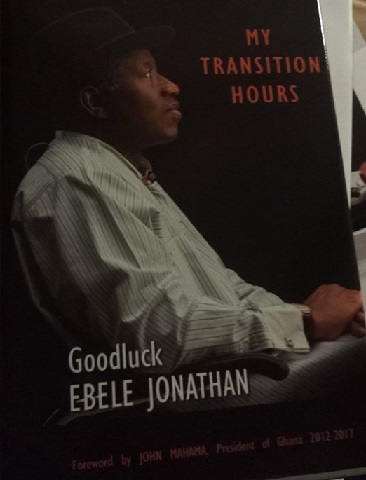
Those are some of the words with which former Ghanaian President John Mahama introduces the long-awaited and much-anticipated book by President Goodluck Ebele Jonathan. President Mahama is President Jonathan’s close friend. In a way they both share a similar destiny. Their bosses died and they both went on to become President. They also both won election as President and later lost their re-election bids. But they are perhaps more united by the shared affinities between Nigeria and Ghana. President Mahama is eminently well-qualified to write the even-handed, thoughtful foreword to President Jonathan’s first book, out of office.
Jonathan is Nigeria’s first President from the South South, first Ph.D holder in Nigeria to become President, first Nigerian President to rise through the ranks from the position of Deputy Governor to Acting Governor, Governor, first Gubernatorial candidate nominee to become Vice President, Acting President and eventually President of the Federal Republic of Nigeria. No other Nigerian, dead or alive, has gone through such trajectory, or rite of passage. President Jonathan was Acting President 2010-2011, following the death of his principal, Umaru Musa Yar’Adua, in circumstances that threw the country into a quandary and raised issues about Nigeria’s geo-politics and the matters of ethnicity and geography, indeed more importantly the right of minorities to also “rule” Nigeria, and if and when they are allowed to do so, whether or not they will be treated fairly.
I have enjoyed the privilege of reading President Jonathan’s first memoir out of office, which will be publicly presented today in the nation’s capital, Abuja, and I can report that it is a book about how Nigeria and vested interests treated him badly. He is the villain in the book: badly treated by entrenched interest groups, treacherous party members, a propaganda and hate-driven opposition and a badly constructed political ecosystem. The book is titled “My Transition Hours.”
In 2011, after much ethnic uproar and conscientious objection by progressive forces, Jonathan won Nigeria’s Presidential elections and remained Nigeria’s President till 2015. He lost the 2015 Presidential election, according to the country’s Independent National Electoral Commission (INEC) but despite his prompt concession to General Muhammadu Buhari, the candidate of the opposition party, the All Progressives Congress, Jonathan has suffered badly under his successor’s watch. He has been maligned, persecuted, harassed, intimidated, humiliated and insulted. His wife has been abused, maligned, criminally tagged and many of his associates have been labelled crooks and thieves. In 2015, in the lead up to the general elections. Jonathan announced that his “ambition was not worth the blood of any Nigerian.” He signed a document to respect the outcome of the process. He kept his word. His successors have rewarded him with odium and abuse. They have done their best to discredit and destroy him.
In this book, “My Transition Hours”, President Jonathan fights back. His public persona is that he is a meek, gentle personality who lacks the guts to fight. Indeed, after the 2015 elections, everyone deserted him. The Aso Rock Villa became ghost town. Nobody picked our calls again. Giants in the corporate sector who used to beg for access to President Jonathan were reportedly now on the Buhari side. Only the Attorney General of the Federation, the security chiefs and a few others came around. The President was left with just his main body, that is – his innermost circle of aides.
We felt hurt by the fact that many of the persons who benefitted from President Jonathan had jumped ship and were now sucking up to the other side. We saw some of the people who called President Jonathan their brother and friend, on the Buhari side less than 24 hours after the election was decided. They were laughing and grinning! It was a painful moment for us. That was the real “Transition Hours” and that was when President Jonathan started threatening that he will write a book on his “Transition Hours”. He chose the title of the book at that very point. He wanted to tell his own story. I am intrigued that he has refused to change the title, but I recall how tough those transition moments were for us. On our return trip to Otuoke, we were treated shabbily by the newcomers. We had to struggle to be recognized. We were treated like regular passengers! The people who took over from President Jonathan were determined to humiliate him. It got much worse later.
In this book, President Jonathan tries to fight back and set the records straight. I am glad he is doing this. I once went to him and asked that we should put a team together to protect his legacy. His response was that “God will fight for us, after God it is government, these people will crush us because they don’t know God, but let us rely on God.” Some people, who thought we should help our boss, ignored this advice tried to put a team together. They ended up in underground cells, and got labelled as thieves! Others fled into exile. It is good to see President Jonathan himself, more than three years later, speaking up. The man that comes through in these pages is the real Jonathan. and that is perhaps the big point: a Jonathan that is confident, strong, clear-headed and assertive, who does not take nonsense and who is very clear in his mind about leadership options. If he had won a second term, Nigerians would have seen a different Jonathan. He worked hard to hold the country together and to prevent mischief from over-running the country. He makes his case in this book as he addresses some of the strong issues that came up during his tenure.
It is not standard practice for a President to justify himself and his tenure. It is also not standard practice for a President to be discredited by his successor. President Jonathan has every reason to write this book. He has chosen the right moment to go public: his successor’s most vulnerable moment. What he does majorly is to tell Nigerians that most of the things said about him were fake news. He insists that he did not abuse power as Nigeria’s President. He argues that every negative thing that has been said about him is an attempt to give him a bad name in order to hang him. He argues that “real strength is power under control”. He adds: “This book is not my biography, as that will come later. This book reveals how I used power as shield in the service to our nation and God.” Jonathan’s argument is that power should never be abused.
The book is defensive and reactive on the vexed issues of fuel subsidy, Boko Haram, “stealing is not corruption,” governance and so on. President Jonathan takes on the major criticisms of his administration. He doesn’t quite provide hard facts but he talks back. The key issues that the book addresses are noteworthy. This is a book that every Nigerian should pay attention to. In this book, a former President of Nigeria is saying that he was badly treated and he became a villain, because he came from a minority part of the country. He states that “people (are) working against our interest”. In this book, a former President of the country tells us that the idea of “one Nigeria” does not exist because we are a divided country. My boss insists: that “there is no patriotism in Nigerian politics”.
He refuses to pull punches. Nobody is spared. In Chapter 3 titled “Politics and Patriotism: The Fuel Subsidy Dilemma”, he argues that “politics in Nigeria and some other African nations is conducted like primitive war”. His major reference is the battle over fuel subsidy in 2012. He argues that the protests over the fuel subsidy proposals were “politically motivated.” Donald Duke should read this chapter. There are some references to him here. Chapter Four is titled “The Chibok School Girls Affair.” The Governor of Borno state needs to read this chapter. He is accused of seizing an “opportunity to politicize an unfortunate incident”. The APC also allegedly indulged in “psychological programming”, making President Jonathan look like a “villain”. President Jonathan rejects the labels. He pointedly accuses the Barack Obama administration in the United States of working against his administration and he provides evidence to back his claims. He accuses President Obama thus: “For some strange reason, the Obama administration had tactically penciled Nigeria and my administration down for failure”.
Hadiza Bala Usman, now in charge of Nigerian Ports Authority, should also read Chapter Four of this book. President Jonathan is convinced that the Chibok girls matter is an act of grand conspiracy, because whereas he took every necessary step, the Governor of Borno State had a different agenda. In Chapter Five, he deals with the question of stealing and corruption. He provides an explanation on that particular matter. The irony is that many of the initiatives now being adopted by the Buhari administration– Treasury Single Account, IPPIS and the BVN were all Jonathan’s initiatives. Jonathan discloses that his government did better on the Transparency International Corruption Perception Index. Chapter Six is focused on “Power Struggle in Nigeria”. Here, Pr5esidnet Jonathan talks about he “strayed into power” and the attack of he majorities on the minorities. In Chapter 7, he offers an account of his “Presidential election campaign”.
He goes further to describe what happened during the 2015 presidential election and how he personally took the decision to save Nigeria from a descent into imminent chaos. Too many persons have tried to write the story of that significant moment in Nigerian history. I am glad that President Jonathan has now given his own account to correct the many lies that may have been told. He records the responses from the international community. It is a rich and detailed account. In this book, ,President Jonathan puts on the table his credentials as an internationals statesman and the goodwill he enjoyed among his peers before and after the election of 2015.
To be fair to him, making Nigeria look good in the international community was one of his major achievements. But President Barack Obama of the United States did not help him, and he refers to this more than once in this book. In Chapter Ten, President Jonathan talks about what he and his team did with the 2014 National Political Conference and his personal commitment to the peace and stability of Nigeria. Needless to remind us that the Buhari administration upon assuming office threw away the report of that conference. In Chapters 11 to 13, President Jonathan takes on other interesting subjects including the youth bulge, private sector reform and the African Renaissance.
This must be a book close to his heart. He uses it to settle scores and to explain the main issues of his era as President. I consider this a must read for all Nigerians and students of the Nigerian process. President Jonathan offers a personal portrait of his own politics, career and achievements. I may have read the book through the prism of a man who was his staff and who was involved, but I can tell that this is a honest and forthright reportage of what transpired. President Jonathan gave to Nigeria his very best. He was conscious of his humble beginnings and he wanted to make a statement. He was a poor man’s son who made it to the highest level in Nigeria. He was an embodiment of the Nigerian dream.
But Nigerian politics is vicious and dirty. You will find a sense of that in this book. He projects himself as a “victim”, but he probably does not tell the full story, which is okay. It means he can tell more stories. There are persons who will read this book and throw tantrums, but may such persons, like Nasir el-Rufai and the Governor of Borno state and all the deceitful associates who fooled the President during the 2015 elections, for reasons of religion and ethnicity, be reminded that this is all told a very kind book. President Jonathan playing the statesman has refused to tell it all. He has held back much more than he has given away. Some of us who were part of his “Main Body” may have now been unwittingly empowered to tell more stories.
I know that my boss is excited by this book. He wants to be remembered for the right reasons and not for the fake news that his opponents reported about his Presidency. President Goodluck Jonathan was President at a unique moment in Nigerian history. His emergence and experience both mark a special moment in Nigerian history. I urge you to read this book, his first one, on what he encountered as Nigeria’s President, before, during and after. Despite the travails of his post-office experience, Goodluck Jonathan, his legacy and value, will survive beyond his “transition hours”. He will, beyond everything else, find a good place in Nigerian history.