

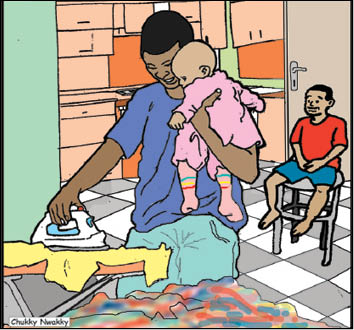
Segun is a stay-at-home parent happily married to Kehinde, an active medical doctor whose services as the Clinical Director of a major county hospital in England are constantly in demand.
DeltaNewsroom.com caught up with Segun while taking his sons to soccer practice after the daily school run. Usually, he races to the groceries, goes back to pick up the boys from soccer, and finally returned home to make dinner before Kehinde got back from the hospital.
All these activities sound normal, but become remarkable when you consider that Segun is a 47-year-old Yoruba man, born and raised in Igbara-Oke, Ondo State, and Kehinde, his wife, is the doctor.
Segun came to the UK for the first time in 1999 after his 33rd birthday. Prior to that time he attended Ijomimo Oluwa High School, Akure, Ondo State and after secondary school he went to Owo Technical College, Ondo State where he obtained an OND in Painting and Decorating / Fine Art. With his OND he found employment as a Graphic Artist in Mushin, Lagos.
Segun got an opportunity to go and do a BA in Fine Arts at the Guildhall University in London (now known as Metropolitan University). So at the end of September 1999 he packed his bags and headed for England.
On landing at Gatwick Airport that cold autumn morning, Segun recalls that it wasn’t the frigid weather which surprised him (for he had been forewarned), but rather it was the neatness and expansiveness of the airport compared to where he had come from. But what really made the biggest impression on him, he says, was his first time at Liverpool Street Station in the East End of London. “It was very different, very quiet, unlike back home where we shout. I was surprised by how quiet and orderly things were at Liverpool Street though it was very busy like Oshodi, people weren’t shouting, they weren’t pushing. People queued quietly without rushing.”
Segun reminisced about a particular incident which occurred during his early days in London when he worked nights as an office assistant from 9pm till 7am and then had to get to university for his class which started at 10am and went on till 4pm. He had finished his shift and was rushing to school. He said, “I saw my bus and with impatience I rushed to the front of the line, as I used to do back home. To my surprise the other people waiting in the queue were just looking at me but they let me enter without protesting. I then felt so embarrassed i wanted to go to the back of the line. But the people were so gracious they said I shouldn’t worry I should just enter the bus. It had a big effect on me. I’ve never jumped the line since then.”
Segun met Kehinde his future wife after about a year of arriving in UK. It was at a friend’s wedding. “I went to the wedding reception with my brother and my 2-year-old nephew. My nephew wanted to use the toilet. By the time we got back to our table, I found a lady in my seat. I couldn’t very well tell her to get up, so my nephew and I had to share one seat. I noticed her because she was talking with my nephew and he was playing with her. I wanted a woman who would be a mother to my children. I knew she was my wife from the start because of the way she related to my nephew and I was impressed by her humility; she didn’t shun me despite my thick accent. One week later I asked Kehinde, a medical doctor, a Registrar living with sickle cell anemia, to marry me. She said no. But I persisted. Two years later she finally said yes.”
And so, to the surprise of an incredulous, skeptical world and despite the resistance of her family, they got married in 2002. By this time Kehinde had been promoted to Consultant.
When their first son Simon was born in 2003, Segun was finishing off his degree and working part time. In the UK, statutory paid maternity leave is for 6 months. His wife took the full 6 months off work to look after the child. Somehow between the husband,the wife and husband’s sister, they managed with looking after their first born. But in 2005 when their second son Fredrick was born they found it difficult to cope.
“Those were tough times,” Segun recalls.
“We went through 3 nannies, an au pair and a relative trying to make it work.
Fredrick was not responding to any of them. He would only cooperate with my wife or myself. My wife had to take one year off work to look after the baby and his older sibling, even though her salary stopped after the first six months. When things became very tough for us financially she had to return to work. My wife still tried to look after the children in addition to her work duties, but she didn’t have the physical strenght to do it all.”
For Segun, the tipping point came when he noticed the combined effect that all these tasks were having on his wife. That was when he made the decision. “My wife was in despair”, he said. “I wanted to preserve her health, so I decided to quit my job and take over looking after the children, bathing them, feeding them and cooking.”
At first it was trial and error, but over the years Segun has perfected the routine. Today Simon is 10 and Fredrick is eight. “I brought the boys up to be independent. I wake up at 7am. We have our family prayer time till around 8am. Then the children bathe, dress and prepare their packed lunch themselves. I take them to school by 8:45am and whatever I do during the day I make sure I’m back at the school to pick them up by 3:15pm. I oversee their homework, then give them additional maths and literacy assignments to do. Once done I take them for their activities, either soccer or guitar lessons. By 6:30pm I make dinner and by 7pm my wife is home and we all eat supper together. Usually Kehinde and the boys are in bed by 8:30pm and I have time for myself till around 11pm when I usually go to bed”.
Segun says he can cook any dish that needs to be made. Kehinde health has stabilised and she has been promoted to Clinical Director. “Whenever my wife is promoted I see it as myself being promoted too. When I met her she was a Registrar, when we got married she was promoted to Consultant and on our 10th anniversary she was promoted to Clinical Director. Up to this period I still support my wife. When she gets back home I can see that she’s very tired, so I do what I can to make sure that she gets enough rest. I still find somethings to do around my children’s activities, usually property maintenance. The way God is elevating us is beyond my own expectation.
“We’ve had challenges but God brings us through. Though I can’t point to a company that I’ve launched, I can point to my wife who hasn’t had a crisis since we’ve been married, who has been promoted regularly in her career, who has given me two beautiful boys who are independent, respectful, well-behaved and God-fearing.
“As the boys get older I hope to have more time to do my own thing, but for now I can never be embarrassed about being a house-husband. This is my ministry, what I’m doing I’m doing for myself and for the kingdom of God. I know that my children will go far with the training they are receiving. This is my joy. As my wife celebrates her 50th birthday I tell her that I am celebrating too.
“My family support me in what I do; they don’t harass my wife because they understand about her health and they love her like their own daughter. My wife is very respectful to me and to my family”.
“My wife is thankful and appreciative of any little effort I make. I married someone who is senior to me academically, senior to me in age but she humbled herself, she respects me, even though she’s the boss at work. She honors me and she is a very good mother to my children. She is thoughtful, disciplined, focused, helpful, kind, God-fearing and intelligent. I am proud of her. I’ve never seen anybody study the Bible as much as my wife. I thank God for giving me this kind of woman who has given birth to my children. She’s a woman of noble character as the Bible describes in Proverbs 31.”
He adds, “Before we got married our church gave us counseling about what to expect and how to plan for married life. The pastor that spoke to us about finances advised us to use a joint account. Both our salaries went directly to the same account. We both have cards for the account.The household expenses are budget on that joint inflow. I don’t use the money anyhow. We use it to take care of the home. I do the grocery shopping. My wife has never accosted me about how I spend money. Nevertheless, any purchases above a certain amount I discuss with my wife first.
“As a Yoruba man I am not comfortable with telling my wife I need this or that, but fortunately she uses her initiative and offers before I ask. She doesn’t throw it in my face. It has never happened that my wife would say hey it’s my money. Never!”
And as for his friends back in Igbara-Oke, Akure and Mushin, what do they say to him? “They wonder how I cope,” responds Segun.
“Some of them tried but they can’t do it they said. But for me, what drives me is the situation in my home. My wife’s health is very precious to me. Anything I can do to make my wife have stable health I will do. I’ve trained the boys to be independent so that when I’m not around they can take care of themselves to reduce the stress on my wife. The boys can do their own breakfast and packed lunch and can get themselves ready for school without supervision.”
Asked what message he’d want the readers to take away from his story. He said, “My Nigerian brothers…I’d like them to humble themselves and not feel they need to oppress everyone in their household to prove that they are the boss in the home. See your wife’s success as your own. So far as your wife is giving you respect, humble yourself. Everybody knows you’re the man but humble yourself. Look at the Queen and her husband Prince Philip. Prince Philip stands beside her as she fulfills her duties gloriously, I choose to do the same.”