

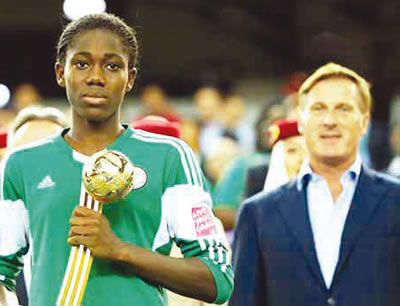
Nineteen-year-old Canada 2014 U-20 Women’s World Cup Most Valuable Player and highest goals scorer, Asisat Oshoala, shares the experiences of her young football career with ’TANA AIYEJINA in this interview
How was the experience at the just concluded U-20 Women’s World Cup, where the Super Falconets emerged second?
I think it was a good outing for all of us. For the team, it wasn’t a bad tournament and for me as an individual, it was okay too.
You emerged the tournament’s best player and highest goals scorer. Were you expecting to attain such height before the tournament?
Actually, I never thought I would be named the best player and highest goals scorer of the tournament. I only gave myself a target. I wanted to perform better than I did two years ago in the tournament. Then I didn’t score a goal because I played from the defensive midfield position.
You had several scoring chances in the final against Germany but you couldn’t convert any. Were you under pressure to score?
I was not under pressure from the coaches or elsewhere. Even I had wanted my teammates to score. I was not thinking about myself. It’s a team game and it doesn’t have to be me all the time. So I tried my possible best, I gave everything that day but I believe that’s the way God wants it to be.
You were not happy while you were receiving your awards. What was going through your mind?
It was a game where we had our chances, a game we were supposed to win. We had the chances and everything needed to win but we lost out. So, you wouldn’t expect me to be happy. I had wanted to make history with the nation; I wanted Nigeria to make history in the whole of Africa. Bringing the cup home would have been a great thing.
The Germans held on despite pressure from the Falconets, took the game to extra time, before scoring the winner. Do you think they were the better side on that day?
No way; they weren’t. We had more than enough chances. we played them hands down. They are a very good side too but we played better despite them winning.
What were your objectives going into the competition?
Like I said earlier, I told myself I had to do better than I did at the last tournament two years ago and this time, I just had to bring out the best in me. I just had to push on and play very good games for the team and for myself as an individual. I told myself I wanted to play well; I never had the intention of winning the tournament’s best player award or being top scorer. I played attacking midfield and defensive midfield, I can play anywhere. During qualifiers, I played from defensive midfield. But on getting to the World Cup, my coach (Peter Dedevboh) said, ‘Go to the front, let me see what you can do for the team.’ So he pushed me to the striking role. Though I am still a midfielder but at the same time I am an attacker.
You can play in so many roles: attacking and defensive midfield; and striking roles. Is it something you trained for or it came naturally?
The football I play is a talent. I didn’t learn it from anywhere. I can play from anywhere. If you watched our game at the World Cup against England, you will realise that I came back to defensive midfield in the second half because our defenders were having a lot of problems at the back and my coach said, ‘Okay leave attacking role and come back to help the defensive players.’ And I did everything at the back. Football needs calculation and if you can calculate very well, you will be able to play from different positions.
Have you tried goalkeeping as well?
(Laughs) No, I haven’t tried that yet.
If you were to choose, which of these positions would you prefer to play always?
I don’t really have a favourite position. I will give my best anywhere I am told to play.
How did you feel scoring four goals in the semifinal game against Korea Republic?
I was very surprised; I never expected it. Though in the previous game, I scored two goals. The Koreans also had a very good side. You know that a team that knocks out the United States must be very good. So, it was unbelievable scoring four times against the Koreans. I was unable to celebrate like I used to do; I couldn’t even dance. I was surprised.
After a wonderful outing in Canada, are you planning a move away from your club, Rivers Angels?
Right now I don’t really have any plans at hand. I am still with Rivers Angels and they are still my club. If there is any move in the future, I will let you know.
How do you think government should reward the Falconets?
That’s left for the nation. I can’t decide for them; they know what is good for us. I think they will take care of that part.
How did you get the nickname Superzee?
(Laughs) It’s a nickname that originated from Super Mario, just like what Mario Balotelli did. The Zee is taken from Asisat.
What were the challenges you faced when you started out as a footballer?
I had a very difficult beginning as a footballer but I was able to handle it and I knew what my parents wanted. They wanted the best for me. I called them and explained to them, that ‘This is what I want for now.’ They said it was okay. I am happy I was able to control the challenges I had then.
What were some of these challenges?
Sometimes my parents would say, ‘If you go out of this house to play football, make sure you don’t come back.’ Sometimes my dad would threaten, ‘If you keep on doing sports, I won’t pay your school fees again.’ I faced so many instances like that but I was able to scale through.
Who do you dedicate your awards to?
I dedicate them to my parents because they were there for me; they gave me all the support I needed.
If you were not a footballer, what would you have been?
(Laughs) I used to dream about being a lawyer. I question people a lot and I interrogate people because I like to know more about things and I like being truthful. If I start interrogating you now, we won’t leave this interview. You will be tired of me.
Do you hope to still study Law in the university?
Well, let’s wait till then. My environment will decide what I will do that time but definitely not now. I am concentrating on playing football right now.
You are the next generation of the Super Falcons. Do you think you can seal a place in the team, considering the highly experienced players in the senior women’s national team?
Actually, before the U-20 Women’s World Cup, I used to play for the Super Falcons. In the last qualifiers, I played in the first 11. I and Desire Oparanozie were able to score four goals each. I think I can cope and the senior players encourage me.
With seven goals in Canada, you are Nigeria’s highest goals scorer ever in a FIFA-organised women’s event. What does it feel like?
It’s a sign of improvement in my career. It shows that I am not going back, rather I am moving forward.
What are the major challenges of women footballers in Nigeria?
I think the way they pay the players is not encouraging. Our income is so low and I think they should try and do something, like adding more money to what the players earn in Nigeria. The government should also try and fix the girls up, this will encourage them. When you earn well, you will be very happy and ready to do even better.
The Falconets also had Uchechi Sunday, Courtney Dike and Loveth Ayila in attack. Which among these players was your best strike partner?
I can play with anybody, as far as you are a footballer. I understand them so well, Loveth, Sunday and Courtney. Even in the Falcons, I never paired with Oparanozie before but when we played together in the qualifiers, we were able to blend together and the coaches were impressed. It was not even up to a week that we trained together but we were able to score goals and it looked as if we had been playing together for a very long time. So, I can play with anybody.
Courtney Dike, born in the US, was the only foreign-based player in the team. What quality did she bring to the squad?
She is an attacker who knows how to position herself to score goals. Her arrival really helped the team. she knows what to do at the right time. She brought a lot of experience from the US and it helped the players as well. We were able to interact and use it. She helped the team as well.
The Falconets scored a lot of early goals in Canada. Was it something you practiced in training?
Not really. I believe it’s the character of the team. We had chances at the beginning of each game and I think it was very good for us because we always utilised the chances.
What is your advice to up-and-coming women footballers in Nigeria?
I will say they should just keep their heads up and keep training hard like I do. I trained so hard and today, I am reaping the fruits.
The African Women Championship is scheduled for next month in Namibia. Do you think the Falcons can bounce back in the competition after losing their title?
Yes, we can, though we lost two years ago and came fourth in that tournament, but this time around, we are expecting something better. I was part of that squad in Equatorial Guinea but the present team will be better prepared this time and I hope we will bring back the cup.
What are the best and worst moments of your young career?
My best moment was when we won the semi-final game against Korea and my worst was the match against Mexico. There was a silly yellow card I collected because of anger. I shouldn’t have done what I did.