
 That the Niger Delta region is exploited, and remains undeveloped is partly our fault. Yes, our fault. Because, for too long, we have not projected ourselves the way and manner other people from other climes have projected themselves. We continue to cry of marginalization, acute exploitation, deprivation, yet, we have failed or refused to do the needful. The region has mass media. The major media houses in this country are owned by people of the Niger Delta region. Electronic media such as Africa Independent Television (AIT) and Raypower, Silverbird and its radio station, Channels television, ITV are owned by our people. What about the print media? We rule the world! Vanguard, The Guardian, THISDAY, these are the nation’s most popular and purchased newspapers! The question is, how well have we utilised these golden opportunities for our good? Perhaps, I should ask, how many of us buy newspapers? How many of us read these papers?
We have not taken opportunity of these media to project ourselves. Many of us are shy, too shy to engage in the ongoing intellectual war. Many of us don’t write columns on newspapers. It is people from other climes that continue to utilize our resources for their good. This local colonialism must stop! It is time we stand up for our rights. It is time we speak up, and stop being docile. This is the time to speak, to project ourselves. Our refusal to speak has done us nothing good.
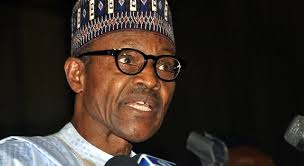
When sometime late last year, the internationally acclaimed writer and scholar, Professor Tanure Ojaide was bestowed the Nigerian National Order of Merit Award (NNOM) for humanities by General Muhammadu Buhari except Dr. Sunny Awhefeada of the Delta State University (DELSU), Abraka who did a highly remarkable tribute essay titled “Tanure Ojaide: Literary Activism and The Order Of Merit” on the “Guardian Literary Series” published in The Guardian of Sunday, 22nd January, 2017, no writer, scholar, and student of literature from the region did a tribute (essay) in his honour! Possibly, some of them were oblivious of that reputed award. For the record, Professor Ojaide is the twelve writer to garner the nation’s highest accolade for intellectual accomplishment!
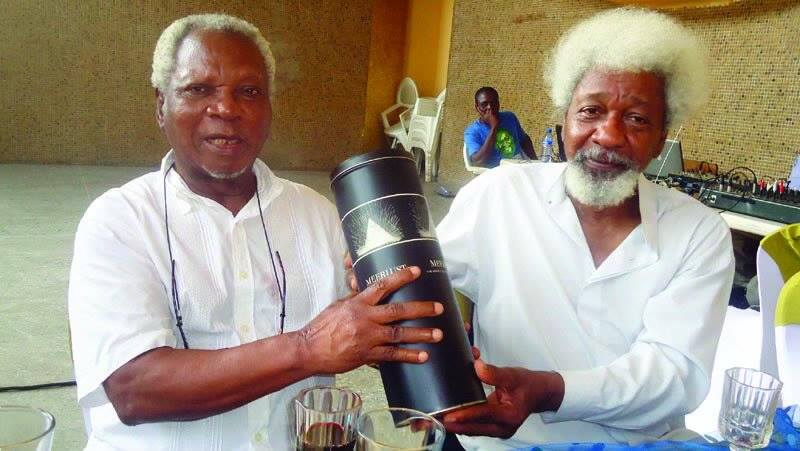
Government and literary bodies national, continental and international are honouring our artists, but we are not honouring and celebrating them. Now, the grand commander-in-chief of creativity and literary excellence, the most celebrated scholar-writer from Africa, Professor John Pepper Clark-Bekederemo was recently conferred with doctorate degree of literature (Honoris Causa) by the University of Lagos (UNILAG), Akoka nobody could write and celebrat him. There is critical silence. If it was a writer from other region, the regions’ writers, and scholars would have written copiously. However, despite our failure, Clark remains a literary big name!
Clark belongs to the post-independence generation of poets of Kofi Awoonor (late), Christopher Okigbo (late), Wole Soyinka (alive), whose poetry are drawn from oral tradition. These generation of poets exemplified Africa’s native literary tradition.
From Clark’s lush poetic imagination, one encounters memorable poems such as Ibadan/running splash of rust/and gold-flung and scattered/among seven hills like broken/ china in the sun, a poem that elegantly describes the crowded/biggest city, Ibadan through radiant metaphors, images, symbols such as “rust”, “gold”, “china”. What about the rhythmic composition “Streamside exchange”, when the child calls and inquires from River bird, river bird/ Sitting all day long/ On hook over grass/ River bird, river bird/ Sing to me a song/ Of all that pass/ And say/Will mother come today?/ and the river bird replies thus: You cannot know/ And should not bother/ Tide and market come and go/ And so shall your mother.
These memorable poems and others in Clark’s impressive collections of poems, The Poems (1961), A Reed in the Tide (1965), Casualties (1970), A Decade of Tongue (1981), State f the Union (1981), Mandela an Other Poems (1988) we chant at schools. They fill our days with pleasure and helped us discover in profound ways “who we are, where we are, where we came from, where we are going”.
Clark’s poetic oeuvre has generated unquantifiable and remarkable critical outputs from scholars and students of literature in Africa and in Diaspora.
In the realm of play and fictional narrative, Clark is a creative and literary behemoth! Check the list of his plays, Song of a Goat (1961), Masquerade (1964), The Raft (1964), Ozidi (1966) The Wives’ Revolt (1981), the trilogy aptly called Bikora plays: The Boat (1981), The Return Home and Full Circle. America, their America is an excellent autobiographical writing. Many writers, scholars have done works on him. The revolutionary playwright, Femi Osofisan published a book entitled, J.P. Clark: A Voyage on him.
Professor Clark who was born on the 6th of April, 1935 to an Ijaw father and an Urhobo mother in Delta State collected and translated with distinction Ozidi Saga, an oral epic performed inimitably on seven-days by the versatile bard, Okabou Ojobolo has universal acclaim.
Professor Clark is a tested academic. He was the first to edit the poetry magazine called The Horn, and many other magazines. He was for many years an astute academic staff at the Department of English of the University of Lagos. He is the author of the influential book, The Example of Shakespeare (1970) Clark is now a professor emeritus, and has legion of awards, prizes, honours. In 1991, he received the highly regarded Nigerian National Order of Merit Award (NNOM) for humanities.
Professor Clark is happily married to Professor Ebun Clark, a compelling theater critic. And they are blessed with children who are defining the world today. His siblings include Senator E.K. Clark a prominent Niger Delta leader and former federal Commissioner of Information, Ambassador Blessing Clark. For now, let’s rise and make a toast for the epic scholar-writer, Professor JP Clark-Bekederemo, a man of letters. CONGRATULATIONS, PROF!!!!!!!!!!!!!!!!!!!!!!!!!!
Comrade Oreh is a student of the Department of English and Literary Studies, DELSU, Abraka