
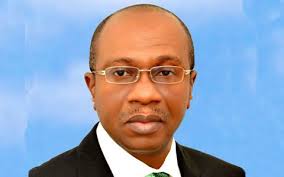
 The governor of the Central Bank of Nigeria, Godwin Emefiele met with some media chiefs at the weekend to discuss issues bordering on the economy, recession and how the misapplication of the country’s foreign reserves. During the meeting, Emefiele spoke on the efforts being put in place to revamp the economy. Excerpts:
QUESTION to EMEFIELE: Nigeria is in a recession, the first in decades. Things are bad and the people are suffering. How did we get there?
EMEFIELE’s Response: I must apologise that this is happening to our people. But I must confess that what is happening today is as a result of a global crisis. Global crisis in the sense that we have seen commodity prices dropping, we’ve seen geo-political tension, all around the world.
But I think when you want to address the issue of how we got here, it is important for us to go back into history, to remind ourselves that there was a time in this country when this country survived only on revenues from agricultural produce.
At that time, I’m talking about the 50s and the 60s and indeed up to the early 90s, Nigeria was the largest producer and exporter of palm produce in the world. Unfortunately, we abandoned these sectors because we found oil. I wish what we did at that time was to hold on to our potential in the agricultural sector. If we had held on to our potential in the agricultural sector, in the same vein held on to the potential (oil) that we found, our story would have been different today.
Unfortunately, what happened was that because we found oil, we let our guards down in the agricultural sector. And I’ll give you an example, this for me is a case of a country that unfortunately didn’t plan properly. Norway, a country with a population of less than five million people, produces agricultural produce, particularly fish. It exports fish today. Norway also produces crude oil, to the extent that today, it has one of the highest investments in the Sovereign Wealth Funds (SWF). Norway, indeed, has $873 billion in its (SWF). Notwithstanding having such a huge amount, Norway also takes very seriously the output from fish production, to the extent that the country survives on the revenue that it generates from fish export.
What does the country do with revenue from crude? It invests it. And at every point, the country is about to use the funds from crude oil. It only uses it for infrastructure purposes. That is a country that has planned for its people. Soon after we introduced the foreign exchange (forex) restriction on the importation of fish, the country’s farmers started complaining to the extent that the Parliament in Norway has met twice to see to how to ameliorate the adverse impacts of not being able to export fish to Nigeria on its farmers. Indeed, the country has sent several trade delegations to Nigeria to encourage us to lift the restriction so that they can export fish to Nigeria and we in turn pay them our hard-earned dollars which we do not have at this time. What we should all realise is that, by allowing the import of goods that can be produced locally in Nigeria, we export wealth and jobs to those countries and import poverty in return.
But, unfortunately we didn’t plan this way for our people and that’s why we are where we are today. And I’ll give you a few examples again. InSeptember 2008, Nigeria’s foreign reserve stood at $62 billion. What did we do with $62 billion? At a time the crude oil price was about N120 per barrel. What did the country do?
What we could have done was to save the money. If we couldn’t save the money, invest it in infrastructure, invest it in industry that would grow productivity and the wealth of our people. But what did we do? The Central Bank of Nigeria (CBN) at thattime went about licensing class ‘A’, class ‘B’, class ‘C’ Bureaux de Change (BDCs).
To class ‘A’ BDCs, the CBN was allocating $1 million per week; to class ‘B’ BDCs, it was allocating $750, 000 per week and to class ‘C’ BDCs, it was allocating $500,000 per week to the extent that between 2005 when the apex bank started selling dollar cash and January 2016, when we stopped it, the CBN had sold dollar cash of up to $66 billion to BDCs. In 11 years, CBN allocated $66 billion, averaging $6 billion per year. If this didn’t happen, we would, comfortably, be having well over $90 billion in our reserve account today and we will not be struggling to pay our bills.
If we had thought of other ways to utilise our reserves in 2008 when it was as high as $62 billion, perhaps certainly, we would not be where we are.